Bridging Method book now available on Lulu.com

The Bridging Method of Construction Project Delivery

Bridging is a better way of arranging the roles of architects, engineers and general contractors that greatly benefits the project owner, especially those project owners who are not in a position to rely upon relationships in the procurement of construction.

    The Bridging method

  • is the only project delivery method that provides the owner with a highly dependable total construction contract price at about or slightly beyond the mid point in the design work and preparation of drawings and specifications and with the project owner having only about half or slightly over half of design cost at risk before having that dependable price in hand.
  • usually saves the owner money in the cost of the project for a fully equivalent end product.
  • greatly reduces the owner’s exposure to contractor initiated change orders and claims.
  • greatly reduces the owner’s exposure to post occupancy costs/delays/disputes arising out of a design or construction error not discovered until after completion or occupancy of the new facility.
  • does not cause the owner’s designer nor the owner any loss of control over the design, design details or the quality of construction.
  • works to the owner’s benefit for a wide range of project sizes and types, including most remodeling and expansion projects, and works exceptionally well on highly complex projects.
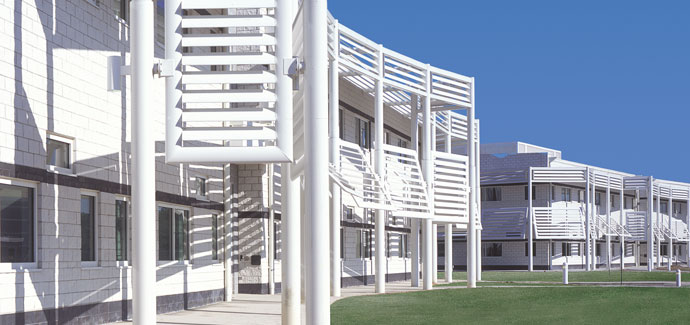
Four projects executed using the Bridging Method.

Four projects executed using Bridging. From left to right: New campus for Georgia Tech in Savannah, Georgia. The Peninsula Mandalay, South San Francisco, California. The Wakefield Luxury Cooperative, Atlanta, Georgia. Federal Courthouse, Las Vegas, Nevada.

The animated chart at right briefly outlines the fundamentals of the Bridging method. However, the key to success in a Bridging Project is the methodology of the preparation of the Bridging Contract Documents (“BCDs“). While this work, which is prepared by the Owner’s Design Consultant (often referred to as the “Bridging Archiect“ or the “Design Architect“) is carried out at about the same time and with about the same level of effort as the work in preparing the traditional Design Development documents, it is significantly different from “DDs“. The method of preparation of the BCDs is more fully described in the Step-by-Step section of this web site.

For projects outside the United States for which the Owner is an American company, governmental agency or individual, Bridging allows the “buyer” of the construction to maximize the use of in-country contractors, architects and engineers while retaining control over the design and construction quality and reducing exposure to unexpected costs.

For facilities to be acquired by a build-to-suit lease Bridging is the best answer for the tenant/user in terms of obtaining the best lease rates and terms for major projects throughout the U.S. and abroad. A 4 page PDF document entitled "In the Interest of the Lessee", which details how to use Bridging for build-to-suit leases, is now available from the Downloads section of this website.

CM-at-Risk/Bridging is a more recent version of Bridging which combines the CM-at-Risk project delivery method with Bridging to provide additional benefits to the Owner. A primer for CM-at-Risk/Bridging can be found in the CM-at-Risk/Bridging section of this website and a more detailed publication on CM-at-Risk/Bridging is available in PDF format from the Downloads section of this website.

Employing the Bridging method for infrastructure projects such as water and wastewater treatment plants, bridges, highways, utility systems, communications towers, tunnels including conductor tunnels, transit projects, airfields, parks and the like is not only quite feasible but has been done with success and has significant advantages for the owner.  For more information go to the downloadable publication, Bridging Method for Infrastructure Projects.

This website and/or information contained in this website were developed by a group of professional architects, engineers and program managers interested in the further development of the Bridging method and making this information widely available at no cost. This site was released on April 10, 2007. Those professionals included Robert M. Bunker PE, George T. Heery FAIA RIBA FCMAA, S. Shepherd Heery AIA, Louis N. “Vic” Maloof FAIA RIBA CMAA, James W. “Bill” Ray PE, and Brinton E. Smith, Jr. RA. The objective is to provide to project owners, other professionals including other program managers, construction managers, architects and engineers, to attorneys and to other members of the construction industry correct and useful information about the Bridging method of project delivery. Contents of this site include downloadable publications which were previously published between 1989 and 2007 and copyrighted by George T. Heery, who serves as Chairman/CEO of Brookwood Group (www.brookwoodpm.com)